


This barn, now on display at Tyneham, was originally located at West Creech Farm, The building would have been used to store next years seed. It is positioned on staddle stones to prevent rodent eating or fouling the seed.
January 2008 – old views

Tyneham Farm had been closed to the public since the evacuation in 1943. Thickets of tangled undergrowth and over sixty years’ worth of accumulated debris are cleared from the site.
February 2008 – new ideas

The Project Manager and a local journalist admire the barn’s spacious and gloomy interior. It has great potential as a display space. Planning and research begin.
March 2008 – Surprise! It’s a cobbled ford
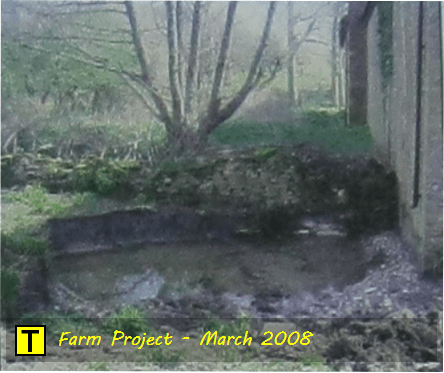
Removal of scrub and nearly a metre of silt from the site of the pond reveal a cobbled surface and a bridge opening built into the dry stone wall. Excavation begins.
May 2008 – star builders
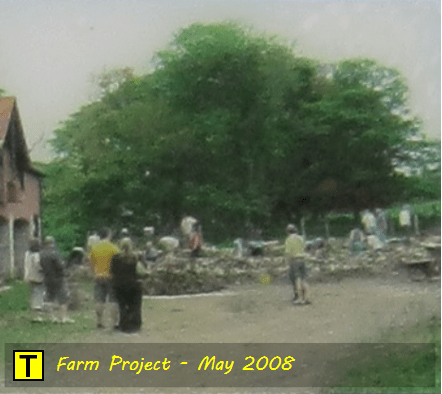
Local people on a dry stone walling training course are the focus of attention. With guidance from expert wallers, twenty beginners, ranging in age from 15 to 65, finish the wall in 3 days.
August 2008 – four big ones
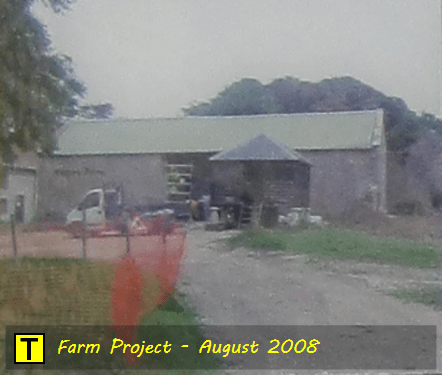
Dangerous stonework and sheets of corrugated iron are removed from the barn doorways, the lintel is raised and two sets of doors are built for the newly christened History Barn.
October 2008 – the splendid arch

After clearing the self-seeded sycamores rooted into the top of the wall, an arched entrance is built into the proposed scented garden. Volunteers had already cleared the interior of undergrowth.
November 2008 – exciting opportunities
A new two metre high fence surrounds the farm keeping out the deer. Tree planting is now possible. Given a head start, in a trench of good soil, the first of over twenty native species are planted.
February 2009 – youngsters get stuck in
Pupils from Montacute Special School in Poole, clear the last of the brambles behind the Granary. The newly dug trench shows the original course of the stream which flowed over the cobbled ford.
March 2009 – that sinking feeling
Heavy winter rain draining from the hills leaves soil and newly planted trees waterlogged. The first of two land drains is installed across the garden by volunteers.
May 2009 – building the bank
A trainer with the British Trust for Conservation Volunteers worked with his small group to build an earth and stone bank. The plants have established well. An end result to be proud of.
June 2009 – the second of many?
Ten beginners are instructed in the art of walling on a training course run by the Dry Stone Walling Association. With another course planned for 2010, this is set to become an annual event.
July 2009 – Groundforce
The Dorset Conservation Volunteers arrive in force. They build a bridge, move tons of Purbeck stone, construct three Gabion baskets, dig a drainage channel (and drink lots of tea!).
August 2009 – all hands on deck!
The Ranges are open for the month of August. Work gathers momentum. The last of the silt is barrowed out, cobbles are uncovered and cleaned, the wall is repaired and extended, meanwhile . . .
August 2009 – ‘hard’ labourers
. . in the History Barn, Lilian Bond’s stage is recreated in the north bay. Purbeck ‘paviours’ are laid over the dirt floor. Eight clear panels inserted into the roof flood the interior with light.
September 2009 – the Squire’s daughter
A quote from Lilian Bond’s book, ‘Tyneham, A lost Heritage’, is routed into the stage planks. Her memories of the Tyneham Theatre productions were the inspiration for the rebuilding of the stage.
October 2009 – the first show for 95 years
The Purbeck Village Quire celebrate harvest in the History Barn. An audience on nearly one hundred, including Lilian’s nephew Major General Mark Bond, are entertained with Victorian song, dance and poetry.
Page last updated: 5 April 2020