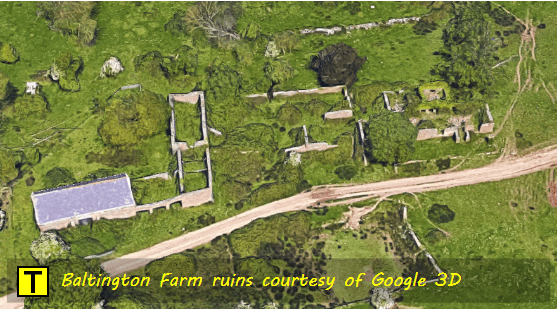
The Longman Family lived at Baltington Farm Tyneham for 30 years from around 1913 until the evacuation in December 1943.
Albert Bernard Longman (1869-1943)
Albert was born on 17 April 1869 at Hurn, near Christchurch, to Thomas Longman (1831-1905) and his wife Jemima Mary Longman nee Wills (1830-1916).
In 1871 his father was publican at the Horns Inn, Dudsbury near West Parley which also doubled as a general shop.
By 1881, the family were living at Firgrove Farm, West Parley. His father was farming 48 acres and employing one man.
By 1891, the family had progressed to Holdenhurst Farm. Albert, aged 21, was a dairyman.
By 1901, the family had moved again, this time to Hurn Bridge Farm. Albert was now a Farm Bailiff.
In 1905 Albert married Emma Caroline Bartlett (1870–1940). Emma was the daughter of farmer George Bartlett (1846-1909) and his wife Louisa Martha Bartlett nee Miller (1846-1907) of Heron Court Farm, Hurn.
Albert and Emma had four children:
- Thomas Herbrand George ‘Tommie’ Longman (1906–1914) – born at Hurn – died at Tyneham
- Louisa Winifred Mary ‘Louie’ Longman (1908–1977) – born at Hurn
- Evelyn Mary Longman (1910–1985) – born at Hurn
- Reginald Charles Augustine Longman (1913–1983) – born at Tyneham
By 1913 the family had moved to Baltington Farm.
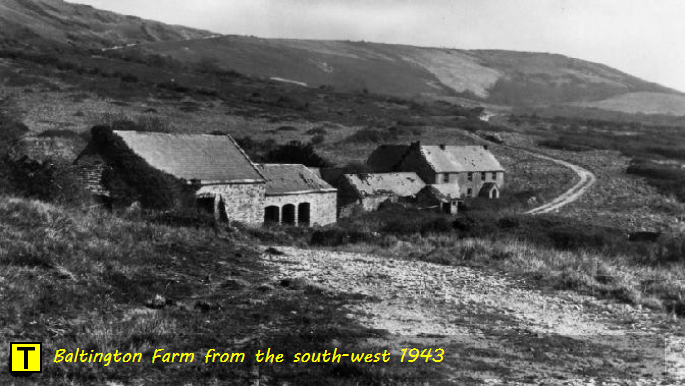
In the 1920s Albert rented out one of his fields between Tyneham and Worbarrow to the Scoutmasters of Eton College for their week-long annual Summer Scout Camps.
In 1932, Albert Longman employed Mr. S Allen, an engine driver.
In September 1939, Albert, wife Emma, son Reginald, daughter Evelyn and housekeeper Lydia Dowsett were still living at Baltington Farm. Evelyn was a dairymaid.
Albert died on 9 December 1943 – believed to be due to the shock of seeing his cattle being sold off so cheaply at the auction.

Albert Longman was my Grandfather and actually died on the day of his sale. He was living in Corfe with my Mum and Dad (Louie and Stanley Sheasby). He may have gone to the sale first and died later. My Mum was brought up at Baltington Farm and went to Tyneham School. Sadly she died before more open access was allowed in the village.
Bridget Dixon
Thomas Herbrand George ‘Tommie’ Longman (1906–1914)
Tommie was born at Hurn in 1906. Sadly he died at Baltington Farm on 22 October 1914 aged just 8 years. It is understood he was kicked in the leg by a cow and contracted TB. Apparently villagers took a door off its hinges to stretcher him.

Louisa Winifred Mary ‘Louie’ Longman (1908–1977)
Louie was born at Hurn o 9 February 1908. She married Stanley Charles ‘Stan’ Sheasby (1904-1960) in 1933 at St Mary’s Roman Catholic Church, East Lulworth.
Stan was the son of Ernest Sheasby (1878-1932) who started a horse and carriage business at Corfe Castle in 1906. The business expanded and motor buses were added. Two tea rooms were opened to cater for visitors. After obtaining a school contract to transport children, he purchased his first coaches. Sadly in 1932, aged 53, he was fatally injured after being crushed by one of his coaches at the Hants and Dorset Depot in Poole. Ernest’s family continued to operate the business and the name South Dorset Coaches was introduced. The family finally sold the 99 year old business in 2005.
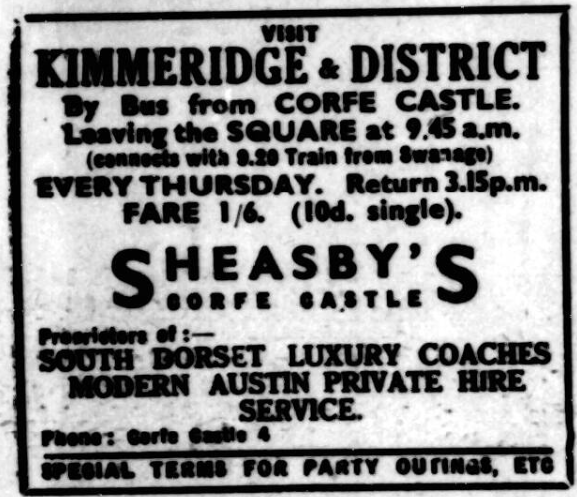
In September 1939, Louie was proprietress of the Castle Tea Gardens, Corfe Castle. Stan was a bus owner. 1
Stan and Louie had a daughter Bridget.
Stan died on 12 July 1960 at the Royal Victoria Hospital, Boscombe, Bournemouth aged 56. Louie died on 30 January 1977 aged 68.
Evelyn Mary Longman (1910–1985)
Evelyn was born on 12 October 1910 at Hurn. She married George Thomas ‘Cudgie’ Wright (1913-1988) in 1940.
Reginald Charles Augustine Longman (1913–1983)
Reginald was born at Tyneham on 26 November 1913.
Reginald married Joan Mary Potter (1921-1973) of Church Hill, Donhead St Mary, Wiltshire in 1943. Her father was a wheelright’s smith. 1
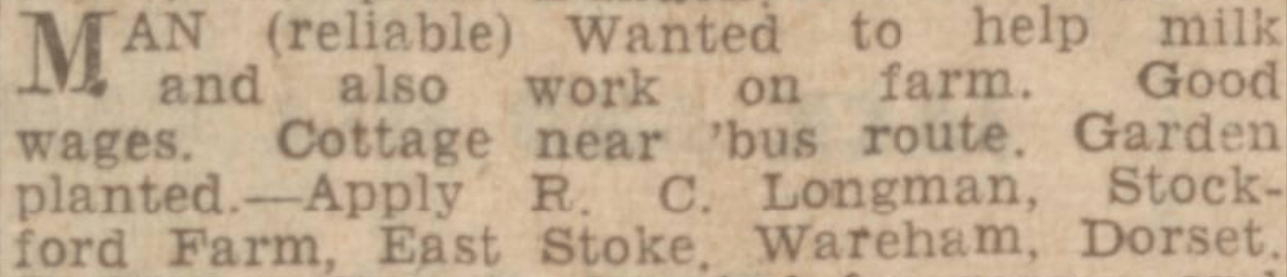
By June 1945 Reginald and Joan were living at Stockford Farm, East Stoke.
Reginald and Joan had five daughters – Rita, Patricia, Rosemarie known as Diane, Janet and Gillian.
Joan died in 1973 aged 51 and Reginald died on 15 December 1983 aged 70. 2 They are buried at East Stoke as too is daughter Diane.
I used to have a drink with Reg when he came into Wareham on Saturday nights, very often in the Black Bear Hotel. He was a very interesting man to talk to.
Martin Burgin-Thorpe
With thanks to: Bridget Dixon, Martin Burgin-Thorpe, Rebecca Cady & Tony Langdown
If you have any photographs or information to share on this or other pages, please email us at the contact address shown on our Home page
Page last updated: 6 September 2022