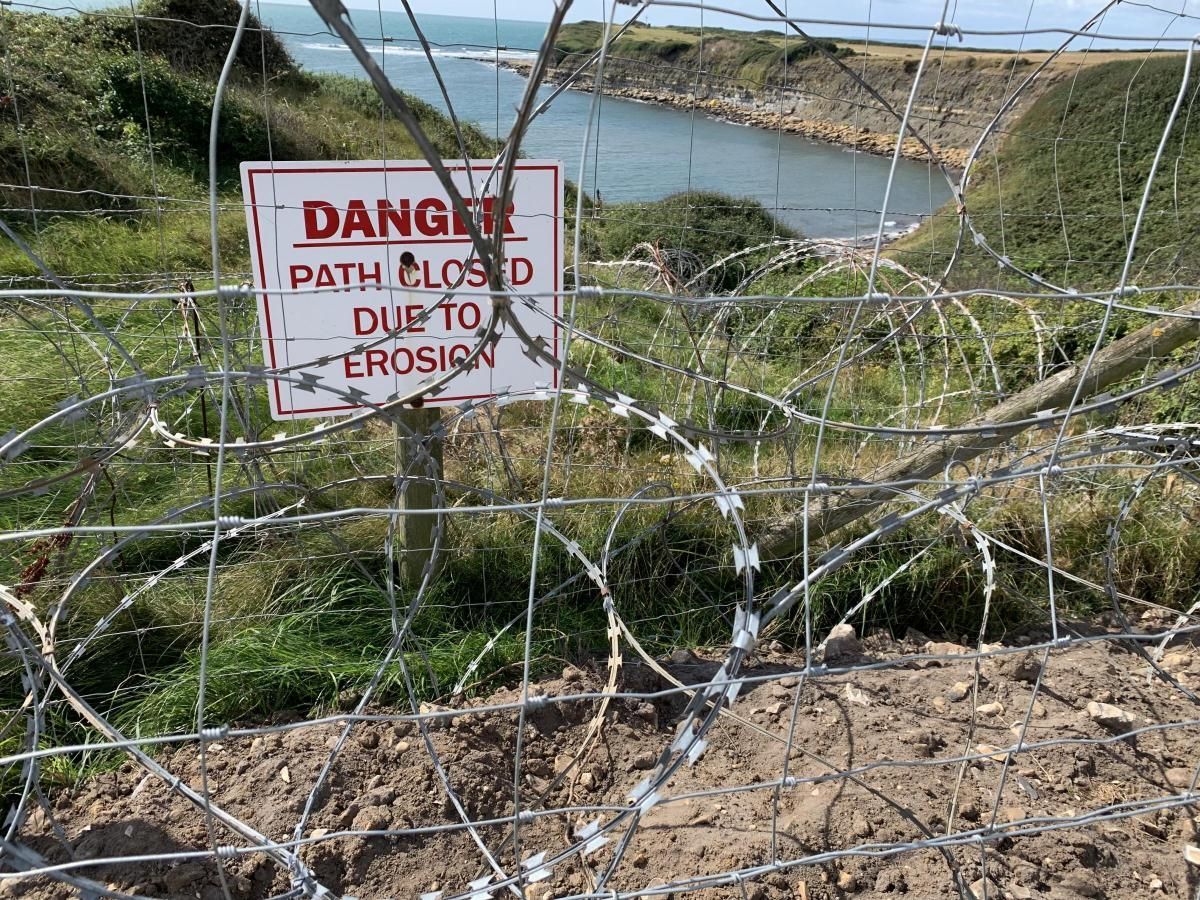
2021: Pathway blocked by razor wire

Main menu


A pathway in Purbeck “used for 50 years” has been blocked off by a “vicious razor blade wire”.

by Ben Williets

The path leading to Broad Bench, near Kimmeridge, has been cordoned off by a barbed wire fence, a move which one resident called “heavy-handed”.

Frances Nicholson, 54, said:

“There’s been a path there controlled by the Ministry of Defence. When they fly a red flag, you can’t go into that. We must be talking 40 or 50 years that path has been there, despite the erosion you can still get down to the beach. What they have done is put up this razor blade wire. During lockdown, surfers were going down that path even when red flags were up.

“I can understand their frustration in them breaking the rules, I feel they have been extremely heavy-handed. “You are allowed to use that path when there aren’t red flags there.”

Ms Nicholson said the wiring was not the “right solution” and called for the path to be restored.

She continued:

“Erosion happens all the time. The path should be made good and there needs to be policing of the red flags if the surfers are ignoring it. I feel it is completely heavy-handed and out of proportion. I can understand their annoyance with the surfers if they are ignoring the red flags but not in respect to this path. They have put this razor blade wiring spilling down the pathway, if someone is stuck on the beach or an animal it is dangerous, it’s totally out of keeping with a beautiful area.”

An MoD spokesperson said:

“Although the Charnel Steps are not a public footpath sometimes the public try to use them to access Broad Bench. The steps are also unsafe due to erosion. This area has been fenced off to make it clear that this is not an accessible route. Our contractors monitor the fence for damage and vandalism and conduct repairs when necessary. Broad Bench is accessible via the beach when the Range Danger Area is open to the public.”

Published by the Bournemouth Daily Echo, 29th September 2021


Page last updated: 7 September 2022

2011: Tall story

Tall Story: Brilliant sketches by an Englishman which were found in a dusty folder show how the Eiffel Tower was built

By Daniel Miller

It was a wonder of modern engineering when it was completed in 1890 and remained the tallest building in the world for an astonishing 41 years.

Now, brilliant drawings by a young English artist of the Eiffel Tower as it was being built have been found hidden away in a dusty folder. They are revealed here for the first time and show the tower’s construction in intricate detail.

The sketches have remained in the family of artist Warwick Herbert Draper since he drew them as a young student in the city between 1887 and 1890.

The never-seen-before pictures show the entire process of the tower being built as well as Parisians enjoying the new attraction in their city.

Detail: A series of sketches have been uncovered by a young British student showing the building of the Eiffel tower. This picture shows the summit with stairs leading to the lighthouse at the very top

They include details of the geology of the area, the foundations, the metal being worked on and people going up in the lifts and enjoying the tower.

Each drawing is annotated and shows what a talent Draper had, combining draughtsmanship and human study.

It is thought he visited Paris several times during the period in which the tower was built and each time sketched what was going on.

The drawings were passed down through his family and his grandson John Ritchie recently found them tucked away in a folder.

He has now decided to sell them at auction where they could fetch several thousand pounds.

In this picture a rudimentary crane is shown hoisting steel sections to workers building a part of the structure. The sketches have remained in the family of English artist Warwick Herbert Draper since they were drawn between 1887 and 1890
Toil: A gang of riveters at work during the construction of the tower. Drawn in black pen, the 17 sketches show the entire process of the tower being built
Draper is thought to have visited Paris several times during the period the tower was built and each time sketched what was going on

Deborah Doyle, from auctioneers Duke’s of Dorchester, Dorset, said: ‘The drawings are of great interest as they show different stages of the Eiffel Tower being constructed.Draper was obviously a very talented draughtsman.’

‘These small drawings show first the geological sections of the strata at the foot of the tower, the position of the four foundation blocks and several drawings of workers at work including one of the Edoux lifts with people changing cars at a height of 650ft.

‘The final drawing of the summit of the Eiffel Tower shows the light-house, laboratories, and the Edoux lift.’

One of Draper’s earliest drawings show the creation of one of the four concrete bases at the foot of the tower
This drawing shows a cross section of one of the lower end of one of the main beams

Draper went on to work as a barrister but continued to draw and paint – skills that he taught himself.

He qualified for the bar in 1898 and later lived at Kelmscott House in Hammersmith, west London, the former home of artist William Morris.

After Morris’s death in 1896, Hammersmith became the centre of the Arts and Crafts movement and a magnet for artists including Frank Brangwyn, Eric Gill and Mary Fedden.

Draper was a leading figure in a range of voluntary and political activities in Hammersmith and Chiswick.

Mr Ritchie, from Weymouth, said: ‘I don’t know much about my grandfather but he worked as a barrister and I believe his art was self-taught.

‘I don’t know how long he was in Paris or whether he visited several times during the construction of the tower.

‘The drawings have been in a folder and they are the type of thing that people might want to see.’

Sketches showing two Parisians going up in the lift and the ticket office at the foot of the tower 
This drawing shows people entering their names at the Figaro newspaper office on the second level of the tower

‘I think he must have been quite a character.’

The Eiffel Tower stands 1,063ft high and remains the tallest building in Paris. It is also the most visited paid-for attraction in the world.

It was named after its designer, the engineer Gustave Eiffel, and was built as the entrance to the 1889 World’s Fair.

Upon its completion, the Eiffel Tower became the tallest building in the world – a title it held for 41 years.

The drawings are being sold at auction on September 29.

Published by the Daily Mail 5 September 2011

2010: Lingering ghosts of a long-dead England

Tyneham in Dorset was already a museum piece when it was shut down during the Second World War. It never reopened

by David Randall

There’ll be another burial in the village next week. Arthur Grant’s ashes will be interred in the churchyard at Tyneham in Dorset. He left more than 60 years ago, but now the last of him will return to the village that laid down its life for the Second World War.

In 1943, the army needed Tyneham to expand its Lulworth firing range, and so everyone was shipped out. Ever since, the only way of becoming a resident again is to die and be buried here. Arthur is believed to be the last of them. Now there is no one with any memory of this curious place which did not wither or change but simply shut its doors and went away.
Even for the time, Tyneham was a period piece, albeit an ambiguous one. For romantics, it was, in its old ways, a keepsake of a once-unchanging England. For modernists, it was, with its broken roadways, its single telephone, and the Bond family owning all the land, an affront to progress.

But, to a few hundred people, it was home. In the early decades of the 20th century, there was Mrs Manktelow, the widow at Double Cottages, the schoolmistress Mrs Pritchard, old Charlie Miller, the Knights, including Fred and his father, coachman to the Bonds at Tyneham House; Charlie Meech, the odd-job man up at the big house; and Mrs Taylor, the village wise woman.

There were two villages here, really. Down the Gwyle, the coombe that led to the sea, was Worbarrow. Then there was Tyneham proper, with its fields of sheep and its Elizabethan manor house. Closer to the green was St Mary’s church; the rectory, home to parsons grand enough to make use of the tennis courts; Dorset stone homes; the one-roomed school; and The Row, the line of terraced cottages punctuated by the village’s only shop.

By the late 1930s, there were cracks in its chocolate-box façade. The school had closed in 1932. There was no pub; Worbarrow’s coastguard station had closed; there was no electricity, no piped water and no development – unless the Bonds sanctioned it.

Then came the war. A radar station was set up on Tyneham Cap, and, to staff it, the Women’s Auxiliary Air Force arrived. They requisitioned Tyneham House, and airmen were billeted in homes. In November 1943, every villager received a letter. “It is necessary,” it began, “to move you from your homes.” By 19 December, all 225 were gone. Many were under the impression they would return, but in 1947 they were told there would be no coming back. Compensation was paid in 1952 and periodic campaigns were mounted to wrest back the village.

They failed, but concessions were made. In 1975, burials were allowed, and the army’s guns are muzzled on 134 days a year so ramblers and curious civilians can once again come to Tyneham. The manor house was demolished in 1967, and thatched roofs have fallen. But the church is preserved, and the school is a museum. In it are the clothes pegs of pupils, and one bears the name Arthur Grant. His ashes will be in the churchyard, but the memory of him, and some of the spirit of the place he once inhabited, lives on.
Published by, and copyright of, The Independent, Sunday 24 January 2010

2008: History wakes up

By Nick Churchill

BENEATH the muck and dust of ages, Tyneham’s centuries-old farm is stirring. For nearly 65 years all that has moved through its stables and stalls are bats, creepy-crawlies and the odd range warden – but a new project is under way that will see these buildings restored and reopened.

Not that it will ever be a working farm of course – Purbeck’s famed ghost village has long since surrendered all possibility of human habitation – but it will provide a unique vantage point from which we can peer into the past.

I’m lying awake at night working out how I can bring the whole thing together, but the idea is to show how the farm worked.

Lilian Bond

Project manager and designer Lynda Price and her husband John have already cleared the pond by the time I find them ankle-deep in mud.

A small double-arched bridge has been uncovered, and so, to their surprise, has the cobbled floor of the stream. “This must have been for decoration, because I can’t imagine why someone would go to all that trouble if they only used the stream to flush away waste from the stables,” says Lynda.

“It’s a puzzle, one of many, but that’s what I love about this job.

“Lilian Bond called this the Pond Yard in her book (Tyneham: A Lost Heritage) but, although she gives very detailed descriptions, I have no idea how this was laid out. I’d imagine there’s a stone road over that bridge as this was the main entrance to the farm from what they called the Lulworth road.”

Tyneham and the surrounding area was evacuated in 1943 to allow Allied troops to exercise in the build-up to the Normandy landings. The villagers and the estate’s owners, the Bond family, never returned.

Retained as part of Lulworth Ranges, for decades it remained largely unseen, gradually returning to nature until the mid-1970s when the Ministry of Defence agreed greater public access on weekends and holidays.

In 1994, the old school was reopened, restored to how it looked in the 1920s. Work followed on the church and many of the cottages with a series of displays explaining village life under what was, to all intents and purposes, the last vestiges of feudal England.

Swanage-based artist Lynda has now turned her attention to Tyneham Farm. “The farmhouse is only two bricks high, so that is lost, as are some of the other buildings.

“But the Great Barn, the granary, stables, tack room and cowsheds are all there. So is the mysterious bull house, which had a chicken coop on top.”

She plans to reopen the main barn as The History Barn, for use by community groups and schools, as well as placing the farm in its historical and environmental context.

One wall appears to have been painted blue. “Well, Lilian Bond talks about the Tyneham Players, and the shows they put on. Her father erected a stage on the north aisle, so it could be that they painted it. She says they used to have up to 160 people sitting in there.”

In the store above the 1904 coach house, Lynda opens the shutter doors and the light floods in.

The original tiles are on the roof and, although part of the timber framing has been patched up, there are materials here that are hundreds of years old.

“Most of this is 1904 because we know the steps were originally on the outside of the building, but the stables, stalls and mangers are part of a much older building.

“I’m lying awake at night working out how I can bring the whole thing together, but the idea is to show how the farm worked and to look at the decline of small farming communities. It will also acknowledge the radar research work at Brandy Bay.”

Lynda is on the lookout for pre-1940s farm implements and excitedly showed me photos of long-redundant chaff-cutters and hay-balers sent to her by a property developer who was impressed by her work at Tyneham.

“You get involved in every aspect of the project – from tracing families to finding the right wood and stone, designing displays and clearing bramble.”

Her boundless enthusiasm surfaces again as she shares with me a letter from the nephew of Walter Case-Smith, the tenant farmer until the early 1940s.

He talks about a much-admired flock of Dorset Horn sheep and how the milk had to be stored overnight in tanks of water to keep it fresh in summer before a lorry arrived to take it to Corfe Castle.

“It’s amazing what you find out – Walter Case-Smith was quite a character. The field in front of the farmhouse was open, so cows, chickens and sheep would be out grazing together. You wouldn’t see that nowadays.”

The last tenant of Tyneham Farm was one S C Churchill. “Now he wasn’t very popular. He was a newcomer for one thing, but he also brought the first tractors to the valley.

“Previously everything had been done by horse, so he laid farmworkers off – and, of course, he got all the compensation when the village was evacuated.”

As with the rest of the work at Tyneham, the farm project is not commercially-driven.

The village remains a gentle oasis for the imagination untainted by tea rooms, gift shops and hi-tech displays, allowing the ruins to retain the mystery that has captured the minds of thousands of visitors over the years.

“I can’t stand that phrase visitor centre’ – it’s so dry and dull,” says Lynda.

“What I love about Tyneham is that it’s a great place for people of all ages where they are not hassled by ice cream sellers, hot dog stands and souvenir stalls.

“The Army does not have a vast budget of taxpayers’ money for Tyneham, so I’ve had to get very good at asking people for things for nothing and the £2 parking fee really does pay for the upkeep.”

Clearing work continues – much of it involving community groups such as the Lulworth Society – but as befits this window on Purbeck’s past, there’s no set date for the reopening of Tyneham Farm. Things have a habit of working out when they’re meant to.

“There is a plan of sorts, but no timetable. There are so many possibilities – it’s very exciting.”

The Great Barn at Tyneham Farm will be open to the public on March 22. If you have old farm implements or other ephemera that may find a home at Tyneham, please contact range liaison officer Lt Col Ken Davies on 01929 404714.

Published by Daily Echo, Saturday 23 February 2008

1975: Tyneham’s ration of nostalgia

HISTORY stopped at Tyneham 32 years ago. Just before Christmas,1943, the villagers gave up their homes to make way for an army firing range, and the village died.

The villagers of Tyneham never went back. Their bitter and protracted struggle for possession of their homes ended in failure as the Army retained control over a hamlet of tumbledown cottages.

Now, as Army range wardens are working to clear up the remains of the village, has come a reminder of those early war years.

Ration books for everyone living in the village before they were dispossessed have been found by the wardens, in an old corrugated iron shed at the back of Tyneham post office.

Names like Everett, Longman, Colin Driscoll, the postmaster, and William Holland, who lived at Baltington Cottage, are still clearly legible on the tattered and crumbling orange and buff coloured pieces of paper.

And the injunction from the Ministry of Food to write your surname and National Registration Number on the counterfoil before handing it to the retailer is clearly visible, too.

Coupons for sugar, bacon and ham, meat and cooking fats are crossed off in blue pencil, for these bits of paper are the remains of used-up ration books, thrown into a pile by postmaster Colin Driscoll some time in 1943.

And there, it seems, they stayed for 32 years.

“We found them as we were demolishing the old shed at the back of the post office,” said warden Mrs. Jane Cato. “They were under a pile of ash on the floor, with rat holes all around. I’m afraid they all break up very easily,” she added.

Mrs. Cato, the only woman warden on the army range, took the ration books home to her cottage in Lulworth, and is now cleaning them up.

“We hope eventually to put them on show, wrapped in polythene, at Tyneham Church,” she told the Echo.

The church, deconsecrated some years ago, is planned by the Army as a museum and an information centre for the public who use the Army range walks when the soldiers aren’t firing.

The books will take pride of place in the museum, particularly as little else of value has been discovered in the village by the wardens.

“There was surprisingly little of value in the village – most of the villagers must have taken everything they had with them when they left,” said Mrs. Cato.

From a dump near the stream they found a few bottles and old inkwells, from the greenhouse of Tyneham House they took a water pump in perfect working order, and from a farmhouse they took a pair of Victorian scales.

But they found little else to stock a museum of old Tyneham.

So those who knew Tyneham in pre-war years will have to rely on the names in old ration books to spark off memories of life in the village.

Memories like those of Miss Margaret Taylor, whose name appears in faded ink on one of the ration books. Miss Taylor, who lives with her sister in Corfe Castle, is a frequent visitor to the tiny 13th century church, which is maintained by the Department of the Environment at the edge of the village.

“We showed her round the old post office and she was amazed to see the huge tree growing just in front of the building,” said Mrs. Cato. “She remembered giving it to the postmaster as a six-inch pot plant about 40 years ago!”

Published by Bournemouth Evening Echo, Tuesday 16 December 1975

1969: Army opens gunnery beaches to public

From a staff reporter

Lulworth, Dorset, Aug. 4

The restricted beaches inside the Royal Armoured Corps Gunnery School range areas which civilians were asked to leave two weekends ago were opened to the public today, the start of the school’s summer leave. The operation of clearing the approaches to the beaches at Mupes and Worbarrow Bays finished shortly before civilian access was allowed.

Residents had complained that the beaches were being used by army personnel while the public was banned.  A protect “invasion” of the beaches was planned for last Sunday but only one family and a couple of holidaymakers went to Mupes Bay. The army did not interfere.

After firing last Wednesday, 40 men spent 1,000 hours patrolling the authorized approaches. A final sweep across the shingle and rocks of Mupes Bay was made a short time before it was decided to let the public on to the beach.

Colonel A.H.N. Reade, commandant of the gunnery school, said it would take months to cover the necessary terrain with mine detectors and would require the checking of every possible bit of metal. The Army point out that if they tackled the area in the way the beaches would “never be open to the public”.

Instead, the patrols search with eyes, boots and sticks, systematically stamping the ground and prodding it to see if there is anything lying on the surface. They cover the paths and verges and 10 yards across the fences, signposted with warnings.

The main dispute between the civilians who want access to the beaches outside firing hours at other times of the year and the authorities is that the military personnel and their families can go down to the beaches with special permission.

Mrs. Margaret Kraft, of Milborne Wood, Dewlish, a vigorous campaigner for the release of the Tyneham Valley from the range area said she was prepared to help anyone who wanted free access to what she regarded as the finest beaches between Eastbourne and Devon.

Lord Salisbury’s plea:

Lord Salisbury, aged 76, said on the I.T.N. programme World in Action last night that the residents, who gave up their homes in 1943 so that the area could be used as a shooting range, responded to the coalition government’s appeal out of patriotic duty. They were told they could return when the war ended but they still had not returned.

Lord Salisbury, a former M.P. for South Dorset, urged the Government to try to right the wrong “which these good people have suffered”.

Published by The Times, Tuesday 5 August 1969

1968: The army reclaims a beautiful spot – for shelling

Letter to The Times

From Philip Howard – Tyneham, Dorset, Sept. 2

All today, holiday crowds lay on the beach at Worbarrow Bay, happily staring up at the craggy cliffs of the Dorset coast. Children screamed in the surf: other people sprawled on the strange grassy mound called the Tout, brooding over their transistor radios, and looking down to Lulworth Cove with the waves frothing in and out of the mysterious caves.

The only difference between this and a thousand other Bank holiday beaches is that it really is one of the most beautiful stretches of wild coast in Britain and nobody will be able to visit again until Christmas. From tomorrow morning the crump of big guns and the squeal of armoured cars and tanks will replace the picnickers and the bikinis.

The bay, the ghost village of Tyneham behind it and the whole valley will be beauty spots no longer. They will become again what they are for the rest of the year, except for Bank holidays and the month of August: part of the 10,000 acres of Royal Armoured Corps ranges, which stretch over nine miles of the coast here, strictly out of bounds to the general public, fenced off with barbed wire, with frequent notices about unexploded shells, and with a lurid placard of skulls and crossbones.

The Army pumps £4m. of shells into the area during an average year.  But never on Bank holidays.

A group of local residents spent the holiday here today in a demonstration to try to persuade the military to give back to the public this piece of the range. Hideous traffic jams built up on the narrow road through the bracken. Many hundreds of people made the pilgrimage between the barbed wire and the rusty skeletons of tanks to the beach.

The campaign did a brisk trade in leaflets and membership forms. There was a nostalgic display of pictures of what Tyneham looked like before it became a range. And all day there was a running dialogue between holidaymakers and the campaigners around their trestle table with their charts and placards.

“You’ve got to have gunnery ranges somewhere. Now, haven’t you?” barked a military-looking gentleman in a blazer.

Crowds peered at the derelict buildings of the village, which has been deserted for 25 years, and looked through the trees for the decaying Elizabethan manor house, which is being stripped of its Purbeck stone.

A 6ft. cross painted red, “marked the spot of a broken promise”, for, when the Government assumed responsibility for Tyneham House in 1943, it promised to return the house after the war.

In some ways, today’s demonstration was almost too successful. The fulmars, which are one of the rare attractions of these cliffs, might find such large, enthusiastic crowds every day around their lonely homes nearly as tiresome as bombardment by tanks.

The campaigners grew hoarse explaining why Tyneham is unique and must be recovered from the Army. The 500ft. cliffs apparently are happy hunting grounds for the geologist. They are thick with fossilized trees and are one of the best examples anywhere of marine erosion of rocks of varying hardness. For the ornithologist there are seabirds he can see nesting in few other parts of Britain. There is the only Iron age promontory fort on the South Coast, which suffers frequent bombardment of a king it was never built to withstand. There is the scenery and the coastal paths and the little beach set in the silver sea.

Whether these arguments will melt the heart of the Ministry of defence is perhaps doubtful. But they certainly sent today’s visitors home glowing with enthusiasm for English heritage.

The first tanks invented came to shoot along this stretch of Dorset in 1916. Gradually, as guns became bigger, Tyneham valley became vulnerable to overshooting, and it was taken over in 1943, with the assumption that it would be handed back after the war. Then , in 1948, and the cold war, the Army compulsorily purchased it. The overshoot area now stretches 14 miles out to sea. And a new line of targets for armoured cars has recently been put up along the line of the cliffs.

Until the next Bank holiday, the fulmars and the cliffs and the view will all be out of bounds again to everything except high explosives.

Published by The Times, Tuesday 3 September 1968

1968: Dorset manor house being given away

By Rita Marshall

The Ministry of Defence has been giving away some of the last surviving parts of the derelict fourteenth-century Tyneham manor house, which for the past 25 years has been on the Lulworth artillery range, Dorset.

Brigadier Martin (Mark sic) Bond, the head of a family that had lived in the house for nearly 500 years, is serving in west Germany. “This is the end of a long, sad and rather disgraceful story”, he told me from Osnabrück, “I feel pretty sour.”

The Bond family, villagers and farmers from the Tyneham valley, were evacuated in 1943. In 1952, after disputes, the war Office compulsorily acquired the house.

Wartime sacrifice

Since 1943 it has been deteriorating. Now, what vandals, weather, neglect and ricochet bullets have left, has been given away to owners of other manor houses and museums.

Brigadier Bond said: “In 1943 when the whole valley was evacuated we accepted it as a wartime sacrifice. It was implied to us all, although not in writing, that it would be all right to go back when the emergency was over.

“Some months ago the Ministry of defence land offices wrote to tell me of proposals to give away some of the pieces of the house that were left. I replied slightly angrily that that was the affair of the Ministry. I no longer had any authority over the house. On that sour note the correspondence ended.”

The Ministry of Defence’s gift has been, for at least two men, a costly business.

Lord Southborough, in his house, Bingham’s Melcombe, near Dorchester, has a stone doorway of the fourteenth or fifteenth century and a porch, dated 1583, from Tyneham.

“I have these pieces because the Royal Commission on  Historical Monuments was getting very concerned about the state of this house in the middle of the artillery range”, he said.

“It makes you want to weep to see an old house in this state. It has cost me four figures to remove, transport, and absorb these pieces into my house, but I regard it as a patriotic act.”

Mr. Robert Cooke, M.P. for Bristol, West, of Athelhampton Hall, Dorset, has stone facing blocks from Tyneham. He told the royal commission that he could not see how to accommodate part of the fourteenth-century Tyneham in his own fifteenth-sixteenth-century home. Eventually he agreed to incorporate some of the stone in works at the rear, which are Victorian in origin and not in keeping with their surroundings. Bringing the stones from Tyneham was costly, he said.

The royal commission said parts of Tyneham had gone to other homes. The National Trust had some stone roofing material which it was keeping until needed.

When it became known that parts of Tyneham were being given away there was local concern. The south-east Dorset area planning subcommittee, who were asked to keep an eye on the house before it was taken over by the Army, called for a report from the Ministry of Public Building and Works.

‘With regret’

The Ministry sent details of the steady deterioration of the property which the planning committee “noted with regret”. The Ministry said that any thought of restoring the house was out of the question. ”There is no public access to the house, it has been falling very steadily into a derelict state. It was thought that to give away the remaining pieces was the right thing to do. The Bond family were consulted and had no objection.”

Brigadier Bond said: “I am very grateful to these public-spirited people who have taken some of the pieces. At least something of Tyneham will be preserved.”

Published by The Times, Tuesday 9 April 1968

1945: Dorset’s new Sheriff

Mr. William Ralph Garneys Bond, of Tyneham House, Corfe Castle, Dorset’s new sheriff, was born in 1880, was educated at Eton and New College, Oxford. He served in the Sudan political service from 1905 to 1926 and was governor of Fung (1922-24) and of Dongola (1924-26). He is a Justice of the Peace for Dorset, having qualified at the 1927 Midsummer Quarter Sessions, and is a member of the Wareham and Purbeck Rural Council.

Published in Western Gazette, 6 April 1945

1937: Killed while riding

Downside schoolboy’s skull fractured

Roderick Maurice Fitzgerald ffrench-Mullen, aged 14, of Downside School , near Bath, whose parents are in India, was killed when he was thrown from a horse at Worbarrow Bay, Dorset, yesterday. He was spending part of his holiday with his uncle, Mr Desmond Nicholas Fitzgerald, a company director, at Tyneham, Boscastle, and went for a ride with his riding master. The horse was about to cross a small wooden bridge over a stream when it momentarily stopped. The boy was thrown, and pitched heavily on his head. His skull was fractured, and he died before an ambulance arrived.

Published by The Times, 11 August 1937

1936 – Tyneham Rectory Roof / Garden Fete

TYNEHAM RECTORY ROOF – URGENT NEED OF REPAIR – GARDEN FETE WITH TWO-FOLD OBJECT

The raising of funds towards meeting the cost of urgently-necessary repairs to the roof of the Rectory, the residence of the Rev. and Mrs. G. Clifford Frend, was the primary object of a fete held on Wednesday in the charming grounds of Tyneham House, which had been lent by Dr. and Mrs. Sauer. Part of the proceeds are also to be devoted towards the expenses incurred in conveying members of the Tyneham Women’s Institute from outlying hamlets to meetings.

The roof of the Rectory is in a very dilapidated condition and far from watertight, and although the rector and Mrs. Frend spent a good deal of money on it when they came into residence in the hope of avoiding further trouble, it was found advisable to call in an architect. The lowest estimate obtained for the work was £735, but with a new scheme the cost has been reduced to £550. Towards this sum promises amounting to about £400 have been received including generous subscriptions from the patron of the living, Mr. John W. G. Bond, C.B., and diocesan funds. The district embraced by the Women’s Institute, which owes its inception to Mrs. Frend, who is the present president, is such a large and scattered one, including Kimmeridge, Steeple, Povington, and Creech Grange, that to enable members to get to meetings in the hut at Tyneham a ‘bus and usually two taxes have to be requisitioned, which represents an expenditure of £10 a year for transport.

THE OPENING CEREMONY.

Mrs. Sauer, formally introduced by the Rector, declared the fete open and wished it every success. Mr. Frend, in thanking Dr. and Mrs. Sauer for kindly lending the grounds, mentioned, apropos the object of the effort, that the Rectory was practically uninhabitable. It was hoped by that afternoon’s effort to raise sufficient to pay off the amount required for meeting the cost of repairing the roof. The Women’s Institute was quite a young and growing branch, and naturally wanted something to feed on. (Laughter and hear, hear.)

Mrs. Sauer was presented with a bouquet of pink carnations by little Miss Clare Farley-Smith (grand-daughter of the Rector) and cordially thanked on the proposition of Mr. Ralph Bond.

THE ATTRACTIONS.

Favoured with brilliant weather, the fete attracted a large number of visitors, who found much to interest them, apart from the pleasure of a stroll through the grounds. A unique feature at night was the flood-lighting of the beautiful Elizabethan house, which is of Purbeck ashlar, commenced in 1567 and mostly built in 1583, although considerable alterations and additions were made by the late Rev. William Bond in 1820. Mr. N. Fitzgerald generously defrayed the whole of the cost of the flood-lighting.

Mrs. W. H. Bond, Miss Margot, Mrs. Ralph Bond, Mrs. Frend and Mrs. Sauer presided at a stall devoted to the sale of miscellaneous articles, whilst members of the Women’s Institute had charge of a produce department and work made by them. Sweets were sold by Miss Margaret Bond and Miss B. Kendrick. Mrs. F. H. Swann was responsible for the serving of teas, whilst Mrs. Bowditch later in the evening saw to the provision of suppers.

Plays, “No Beggars or Hawkers” and “King or Clown?” were presented by “The Barnstormers”; “Estelle,” clairvoyante and crystal gazer, gave demonstrations, whilst various competitions added to the visitors’ interest and augmented the funds. Amongst the side-shows, &c., were a Chinese laundry, run by Mrs. Donald Leney; a treasure hunt, the charge of Mrs. John Evans; bowling, at which the helpers included Dr. Dru Drury and Mr. Ralph Bond; cocoanut shies, in the care of Mr. T. W. Wrixon; darts, Messrs W. H. Clifford Frend, C. H. Bayliss, and G. N. Walton; Mr. D. Squires (Kimmeridge) persuaded “anglers” to fish for bottles in a bath; and a whist drive on the lawn, with Mr. A. Dunning as M.C., followed by dancing to music by Wareham Town Band, were fitting finales to an interesting programme.

Messrs. J. H. Heard and Hy. Grant were responsible for preparing the ground for the fete.

Published by the Western Gazette, Friday 28 August 1936

1935: Tyneham House let

Tyneham House, Corfe Castle, a Dorset property that dates from 1580 and has been owned by one family for 250 years, has been let furnished on lease by Messrs. James Styles and Whitlock (St. James Place).

Published by The Times, Thursday 31 October 1935

1935: Unspoilt Worbarrow Bay

unspoilt worbarrow bay

Dorset Beauty – Warbarrow Bay – Unspoilt English Splendour

[By Stephen F Aylett]

Seeing that the majority of our people live inland, it is not surprising that the many charming nooks and coves that form our coastline, should provide the change required by those who seek an environment of contrast for their annual relaxation or periodical excursion.

The ease with which the travelling public may reach their destination is rendered more simple and swift , as each year increases the efficiency of our transport systems, so that to find a quiet retreat necessitates a journey almost as far west as Cornwall; the time and cost of such a distance eliminating a vast number of would-be holiday-makers. Peaceful corners do exist, however, and I want to take the reader, in imagination, to a little beauty spot on the Dorset coast, a small stretch of sea-shore, that remains as primitive and natural as it was in the dawn of civilisation, except perhaps, that the sea, in its tireless onslaught has penetrated further inland, washing out the least resisting of its obstacles. If you already know the place, a brief description of its charms should not be amiss, but if by chance the locality has not been brought to your notice, you are hereby charged to honour and obey the moral rules and regulations which preserve this scenic treasure from the modern Vandal.

The Approach

So then, let us start from East Lulworth, taking the first turning past the Inn, if travelling from Wareham, or the first before, if coming from the west. This road gradually increases in elevation, until it reaches a gradient of one in seven, winding up the side of a tall hill, that at present shuts out all sight of the sea, presenting to the traveller a wall-like bank of grass on his right and the bramble covered slopes on his left, that stretch down and down to the valley below, forming a wonderful panorama of Dorsetshire countryside, with Lulworth Castle at the base, Wareham in the distance and a view that extends over several counties, becoming enhanced in loveliness as our height grows steadily upwards. The only diversions from our contemplation of this verduous landscape are the three gates, through which we must pass, barriers across the road, at irregular intervals, each one under the care of a voluntary attendant who opens and shuts them to facilitate our passage – thus earning the monetary recognition scattered from the windows of the moving car – the gates, being no doubt, the legal symbols of the right-of-way, through which we pass.

Reaching the summit, our road bears to the right and runs down the other side of the hill, to a little hamlet, known as Tyneham, and as we traverse this declining roadway, we observe at our feet, a perspective of our objective, Warbarrow Bay, being the nest-like erosion into the valley below, bounded each side by small hills, that eventually grow to the cliffs on the shore.

The Antidote to Hurry

Those of us who are confined to office or factory every working day of our lives, with no aspect beyond the piles of bricks and mortar that surrounds us and no sound but the clicking of typewriters, ringing of telephones, or throbbing of engines, learn to distinguish inside us a craving for the soothing amenities of nature in the raw, which alone can provide the antidote to commercialism and satisfy the very definite yearning of our mental requirements. After all, just as the hunger-stricken victim suffers from the need of physical nourishment, so that unknown component of our being, that we call mind or soul, insists upon the beauties of sea and landscape. We cannot yet measure the effects of light and colour upon our system, but we know, most certainly, that our brain reacts to them, leaving deep impressions and creating a powerful influence upon our emotions.

Thus, our glimpse of the ocean awakens our sense of the infinite, as we leave the car at Tyneham and pass through a little woodland, a tiny arcadia that is complete with stream, rockeries and footbridges, all in a pleasing and rustic manner, the path ultimately leading us to cultivated fields, by the side of which we pass along, the only remaining track that divides us from the sea.

The Bay

We enter the bay, by the only passage, from the north-east corner and are at last confronted by the unique beauty of our quest, an enchanting little cove, that resembles Lulworth in all respects, excepting that its cliffs are not so high and its shape not quite so circular, but dissimilar in its one important feature of virginity. Here in the full of summer, the sea approaches in gentle progress upon the shingley beach (its only defect), washing the shallow basin of its semi-circular formation with a light blue water, that is pleasingly transparent and offering a particularly safe bathing place, to the few who know of its existence. The eastern side (assuming a circle to contain sides) is the only portion of the beach to be accessible, it being a stretch of piled up rocks of small dimensions, that just represent a whim of the tide in its method of orderliness, but our eye picks out, here and there, the bright hues of a silk sunshade that shelters into enterprising Eve who has manipulated the boulders, to gain a position of advantage at the water’s edge.

The white clay-like substance of the cliffs all round, stretch up to the grassy slopes above reflecting the sun’s rays, to the bay beneath – a fact that would account for the agreeable temperature of the water. The cliffs are so straight, in parts, that they form a rough right angle with the green of the grass at the top, giving one the impression that the bay has been cut out by the knife of a giant hand. There are one or two clefts in the precipices, which have been made by the continuous drainage of the adjoining land, each of which becomes periodically congested by the more crumbly substances of inundated soil.

The only residences are little homesteads that could be counted upon either hand, including the one construction that in any way suggests modernity. These little cots contain natives who were born in them and the visitors who share their humble abodes with their low ceilings, tiny windows and stone floors, during the holiday months are families that have done so from generation to generation, it being recognised that they or their children will continue to do so for all time. Camping and caravanning are strictly forbidden in all, leaving accommodation for the stranger an impossibility.

A Proper Guardian

The owner of the land obviously belongs to the type of landlord who, alas! are becoming few in number, as days go by. The type of person who guards the unspoiled features of his property with a passionate autocracy – and therein lies the secret of this flawless gem, amidst a portion of disfigured countryside – evident signs of his attitude being noticeable in the remains of the two coastguard cottages , the inhabitants of which insisted upon letting them to people, detrimental to the surroundings, with the result that he ejected the tenants and pulled down the cottages. The few existing structures possess the usual appurtenances of their kind, the piles of fishing nets, lobster pots, upturned boats and so on, lying haphazardly about, whilst a small lifeboat house stands by the beach, erected of grey stone slabs, the time stained surface of which seem to have a story of their own.

Looking out of the bay, we observe the passing of small craft, the sails of which seem to sway lazily to the feeble zephyr, a little to the right, or west, we may discern the faint outline of Portland Bill, while right out on the open sea, we catch occasional glimpses of ocean liners, appearing like toys in the distance.

A Sunshine Trap

Thus, as we are lucky with the weather, we are confronted with a picture that will for long stimulate our memory to joyful reflection. This rugged cove with its wealth of unaffected beauty, seems to veritably trap the sunshine which glimmers and sparkles on everything it touches, causing the gently flowing waves to flash a myriad beams of gold, that are lost to oblivion, as the fresh born ripple radiates its new-formed gleam of light, piercing in every direction an atmosphere of azure, the rich blues of sky and sea, that fill the background of our living canvas.

The lapping of the waters mingle to the sound of child laughter, and from above we hear the sharp shrill note of the seagull, as it drifts from cove to cove, along the shore, and amid this harmony of enchantment, we subconsciously detect the humming of a far off aeroplane, the sinister potentialities of which loses its menace, regarded from our blue lagoon, but reminds us, none the less, that only round the corner is the world of every day realities.

One other feature of our surroundings brings us to earth, as we notice the girls along the beach, who unblushingly change their ordinary attire for a costume of scant proportions, in which to romp and bathe in the inviting water. This dates our period to the twentieth century, the day of emancipation for the gentler sex and when we remember that less than a century ago our sisters were forbidden outside the door without a chaperon, which accompanying them to the water’s edge, would watch them decorously enter and leave it – the bathers costume’s enveloping every inch of person, from tip to toe – we realise that our women folk have progressed far along the road of reason.

Lastly, in respect of time, our thoughts might wander above to the cliffs, upon the edge of which are the ancient burial mounds, containing the long silent remains of our Stone Age ancestry, and incidentally, giving name to our dream cove, Warbarrow Bay.

Published by the Western Gazette, Friday 13 September 1935

1925: Farm labourer’s fatal accident near Coombe Keynes

Fall from Farm Waggon – Bournemouth chauffeur as principal witness

The tragic circumstances under which George Cleall (43), a cowman employed at Povington Farm, East Lulworth, met his death whilst returning from Hethfelton Farm with a load of straw on a haorsed waggon, formed the subject of an enquiry by the Deputy Coroner for East Dorset (Mr. R. D. Maddock) at Povington Farm on Monday.

Bessie Cleall, of Povington, wife of deceased, giving evidence of identification, mentioned that her husband had been working for Mr. T. W. Wrixon for about 16 months. Deceased was quite well when he left home about 7 a.m. on Saturday, and he had no serious illness. He never complained about his work. There were two children, one aged four years next June and the other 1 year 6 months.

Chauffeur Witnesses the Fatality

Wm. Chas. Elias, chauffeur, of 18, Poole-road, Bournemouth, stated the previous Saturday, about 3.30 to 3.45 in the afternoon, he was with his employer on the road between East Lulworth and Wool, near Coombe Keynes, and saw two waggons laden with straw about 300 yards apart. Witness had passed the first waggon with the car, and then saw the top of the load on the rear waggon when 120 yards away. The waggon appeared to be coming towards him rather quickly, and he therefore drew up at a “widish” part to let it pass. Then the horse appeared round the corner, trotting, and the man in charge, who was on the near shaft, jumped off and seemed to get under the wheels of the waggon. The horse continued at a running pace, bringing the waggon towards him, and the witness waved his arms at it to prevent it colliding with the car. The horse, however, continued on its way, avoiding a collision, and witness jumped out of the car and went to the man, who was lying on the road and had not moved, and, as far as witness could judge, was dead. There was a bruise at the side of the deceased’s head, and blood was coming from the left ankle. Witness hurried to a farm on the right-hand side of the road to get help, and a man on a motor-bicycle went to summon the police. A policeman and doctor came some time later. Witness did not see anyone on the road at the time of the accident except the lady in the car. The road was a fairly hard stone one, and was quite dry.

Thomas Walter Wrixon, of Povington Farm, East Lulworth, the deceased’s employer, informed the Coroner that on Saturday Cleall left the farm with a horse and waggon to bring straw from Hethfelton Farm, being accompanied by another man with a two-horse waggon. Deceased had done the same journey for the same purpose 15 to 20 times during the past winter. The animal he drove was a mare aged about 10 years, and perfectly quiet. Cleall had never complained about the horse when he had had it out. Deceased was a steady man and a very good worker indeed. The road near the corner referred to was very narrow, with a very bad corner, and on the descent. Deceased was a good man with horses, one could not have a better man, and he was active and quick naturally.

Erneest Corbin, dairyman, of Coombe Keynes, stated that deceased stopped his horse and waggon at witness’s gate on Saturday afternoon and they had a conversation about Cleall’s dog. Witness saw deceased go down the road towards Povington, leading his horse. A few minutes later a man came and told him that there had been an accident. He found Cleall lying on the road towards his left side, quite dead.

P.C. Beviss (Wool) said on receiving information of the accident about 4 p.m. he told Dr. Anderson, and together they went to the scene of the fatality. Deceased was taken to Mr. Ford’s farm close by and there examined by Dr. Anderson, who found deceased had died of a fracture of the base of the skull. The left leg was also broken, and there was a cut on the right knee. There was a large abrasion on the left bottom jaw, which might have been crushed by the waggon passing over it.

The Coroner (who sat without a jury) returned a verdict to the effect the death was due to a fracture of the skull, caused by the farm waggon passing over deceased’s head, the injury being accidentally caused.

Published by Western Gazette, Friday 10 April 1925

1923: Letter to the Wiltshire Times

The proposed Tank School at Lulworth

Sir: Permit me, on behalf of the residents and, more particularly, the fisherman of this bay, two miles east of the Tank Corps gunnery range near Lulworth, to urge the public and national need for preventing this monstrous local nuisance.

Mr. R. D. T. Yerburgh, M.P. for Southern Dorset, is right in saying that its perpetuation will exclude the public from access to some of the finest of the Dorset coast and impose irksome restrictions on local fishermen.

The creation of the range in war-time was one of the many ugly necessities to which the community was bound to submit. Its continuance, with noisy din of gun practice, admitted risks of unspent shells, essential uncertainty as to when the practice must bar all walking on these splendid cliffs, and the direct interference with the useful and already precarious business of the local fishermen, constitutes a severe indictment against the Government Department concerned, whereas it is just a case where, even in England, the Government should give a lead in preserving in the amenities of this lovely bit of coast, one of our precious national possessions.

For such a gunnery range, waste ground like that of Salisbury Plain or the sands off Shoeburyness should be selected, and not a line of coast-wise downs which hardly has its equal for beauty and accessibility in the whole of England.

Yours faithfully,

WARWICK DRAPER

Sheepleaze, Worbarrow, Near Corfe Castle, Dorset.

August 15th, 1923.

1920: Tyneham – War Memorial

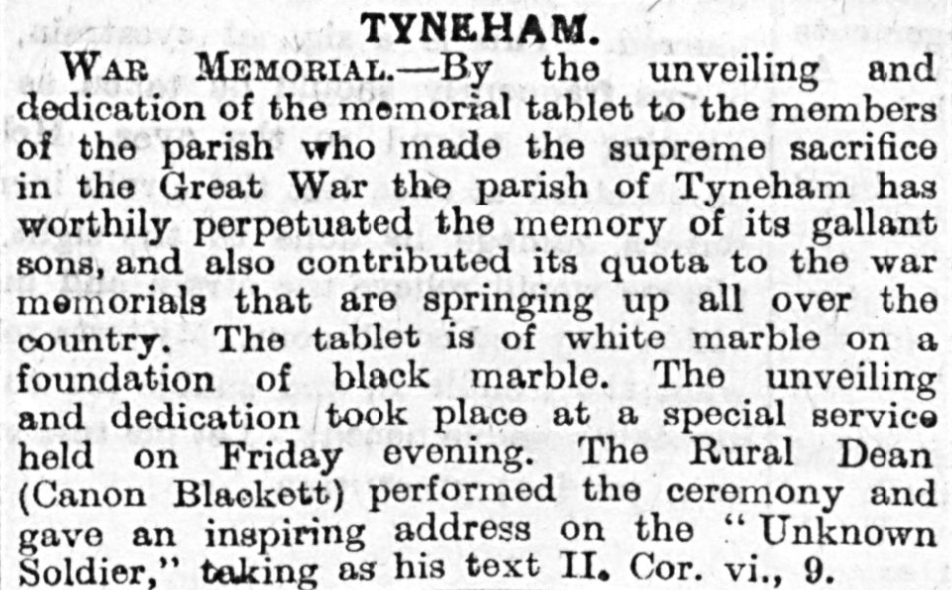
By the unveiling and dedication of the memorial tablet to the members of the parish who made the supreme sacrifice in the Great War the parish of Tyneham has worthily perpetuated the memory of its gallant sons, and also contributed its quota to the war memorials springing up all over the country.

The tablet is of white marble on a foundation of black marble.

The unveiling and dedication took place at a special service held on Friday evening. The Rural Dean (Canon Blackett) performed the ceremony and gave an inspiring address on the “Unknown Soldier,”, taking as his text II. Cor. vi., 9.

Published by the Dorset County Chronicle, Thursday 25 November 1920

War Memorial Tablet copyright Michael Day

Please visit the War Dead page for more information about the men listed and others connected with the parish who gave their lives in the service of their country.

1914: Air Rifle Shooting

On Wednesday evening last week the members of the Povington Club visited Tyneham to shoot the return match to that won by the former Club by seven points on February 7th. Tyneham now won by 19 points, making 184 points, and Povington 165. Scores:- Tyneham – J. Curtis (captain), 23; T. Gould, 22; F. Knight and B. Taylor, 21 each; C, Meech and F. Lucas, 20 each; W. Meech, W. Stickland, and W. Warr, 19 each – total, 184 points. Povington – C. Charles and W. Runyard, 21 each; C. Beauchamp, 20; W. Taylor, 19; W, Cooper, M. Charles, and A. Taylor, 18 each; B. Charles, 16; and A. Norman, 14; – total, 165 points. –

Tyneham v. Frampton (Dorchester). – This match was shot on the same evening, each Club firing at patent targets on their own range. Tyneham won by nine points. Scores:- Tyneham – J. Curtis,23; F, Knight and F. Lucas, 22 each; W. Warr, 21; T. Gould, W. Meech, and B. Taylor,20 each; T. Miller and F. Warr, 17 each – total, 237 points, Frampton – A. Biles, G.H. Whatmore, F. Hansford, and Carter, 21 each; W. Hill, Rev. C. S. Homan, and J. Legg, 19 each; C. Watkins, 17; and E. Dart, 16 – total, 228 points.

Published in Western Gazette, Friday 6 March 1914

1910: Forthcoming Marriages

Mr. L.L. Yeatman-Biggs and Miss Cicely Bond

The marriage of Mr. Lewin Legge Yeatman-Biggs, son on the Bishop of Worcester and the late Lady Barbara Yeatman-Biggs, to Miss Cicely Bond, daughter of Mr. William H. Bond, of Tyneham House, Wareham, Dorset will take place on September 6 at Tyneham Church. The Bishop of Lichfield, the Bishop of Worcester, and the Rev, C.S. Homan will officiate. There will be six bridesmaids – the Misses Lilian and Margaret Bond (sisters of the bride), Miss Yeatman-Biggs (sister of the bridegroom), the Misses Barbara and Elizabeth Yeatman-Biggs (twin nieces of the bridegroom) and Miss Evelyn Blake. Sir Randolph Baker, M.P., will be best man. The reception will be held at Tyneham House, and the Bishop of Worcester has lent Hartlebury Castle for the honeymoon.

Among the wedding presents are the following:- A gold-fitted dressing-case from the Bishop of Worcester; a silver tea-pot and coffee-pot from the Earl and Countess of Dartmouth; an armchair from the Earl and Countess of Iddesleigh; four pierced gold-fruit dishes from Lord and Lady Knaresborough; a dinner service from the Bishop of Lichfield and the Hon. Mrs. Legge; a silver sugar-bowl from Viscount St. Cyres; an antique table from Lady Octavia Legge; an old chair from Lady Wilhemina Brooke; an umbrella from Lady Croft; and a leather blotting-book from Major and the Hon. Mrs. Geoffry Glynn.

Published by The Times, Tuesday 30 August 1910:

1910: Parish Meeting

The annual parish meeting was held in the Schoolroom on Saturday evening, the Rector (the Rev. C. S. Homan) being in the chair.

Mr. W. H. Bond 1 proposed the re-election of Mr. Homan 2 as chairman. Mr J. Bascombe 3 seconded, and it was carried unanimously. Messrs. Job Chilcott and Walter C. Smith 4 were unanimously re-elected overseers, and thanks were accorded them for their past services.

The Chairman announced that Mr. W. H. Bond had kindly became guarantee to the Postmaster-General for the necessary amount required for the restoration of the postal telegraph service to Tyneham, which was suspended on the removal of the coastguard, and a hearty vote of thanks to Mr. Bond for his action was carried with acclamation. The restoration of the telegraph service will prove a great boon to Tyneham.

The Chairman was cordially thanked for presiding.

Published by Dorset County Chronicle, Thursday 24 March 1910.

  1. William Henry Bond (1852-1935) [↩]
  2. Claude Samuel Homan (1867-1947) [↩]
  3. James Bascombe (1849-1911) [↩]
  4. Walter Case Smith (1861-1948) [↩]

1906: Tyneham School

SCHOOL CHALLENGE SHIELD. – This school has won the challenge shield for the East Dorset Division this year.

DR. BARNARDO’S HOMES. – A collection box has been made by the school children in aid of Dr. Barnardo’s Homes with the following results: – Irene Knight, 13s 7d; Lizzie Restreux, 11s 6d; Lizzie Cleall, 6s 10d; Reggie Bascombe, 3s 6d; Ethel Minterne, 1s 4d; Harry Dart, 1s 7d; Harry Kellaway, 1s 3d; Lucy Dart, 1s 5d; Jessie Minterne, 3s.  This, with 8s from the school box, to which Queenie Pittman and Bertie Taylor subscribed regularly, made a total of £2 12s.

Published in Western Gazette, Friday 21 December 1906

1898: Local Football News

TYNEHAM v.  WARBARROW (A.)

At Tyneham on Saturday, teams representing the two schools met. Willie Healey was captain of Warbarrow team, and Francis Willcox of Tyneham. This being a first match, the players were greatly excited. The kick-off was at four p.m., and the first goal was scored by Jesse Cooper, who was loudly cheered. The game terminated with Warbarrow leading by four goals to one. After the match light refreshments were provided by the Rector. Mr. G. Selby was referee.

Published in the Western Gazette, 11 March 1898

1893: The Royal Wedding

THE ROYAL WEDDING. – A tea for the people of Tyneham was given at Warbarrow by the Rev. J. Bond, of Tyneham House, to celebrate the wedding of the Duke of York. At the same time and place Mr. N. Bond, of Grange, gave a tea to the children of Holme, Grange and Steeple, and to such of the older people as could come. The children were driven over in waggons, and at once began to make the most of their time by bathing, going in the boats provided, and other seaside pleasures. At four o’clock the children were summoned to their tea, which was prepared just in front of the Coastguards’ houses, the scene being enlivened by flags, some of which had been hoisted by the Coastguardsmen, while others, which had been brought by the children in procession were now planted in the grounds at the top of the green. When the children’s tea was over, the elder folks gathered round and enjoyed the plentiful supply of good cheer. Mr. Bennett‘s well-known cakes and bread being as good as ever, thorough justice was done to them.  Altogether more than three hundred persons were thus entertained. Various races and sports were then improvised, conducted by Messrs. Chilcott, Nineham, Ogle, &c., and the onlookers seemed much interested, and applauded loudly. A concertina being forthcoming, some of the party were soon dancing, and the evening was so still that the music was sufficient to enable the dancers to keep step. About eight o’clock, as the more distant folk were preparing to leave, the Rector suggested that “God save the Queen” should be sung, which was done heartily without accompaniment. Then three cheers for Her Majesty were given with a will, led off by Mr. Ward, the officer in charge. Three more for the Duke of York and three for the Duchess followed. After that three for “Our entertainers,” the two Messrs. Bond, were enthusiastically given, and three more for the Rev. Canon and Mrs. Wordsworth and Mr. and Mrs. Filliter. The Rector responded by calling for three cheers for Mr. Ward and the Coastguards generally, who so greatly contributed to the success of the entertainment. After this dancing and races went on again, as long as the light lasted. The feature of the evening was the extreme good temper of the company, even the losers of the races coming in with a broad grin, and joining in the laugh at the good-humoured jibes bestowed on the laggards. Altogether it was a most delightful gathering, the weather perfect, the little bay looking at its best, and everyone on good terms with themselves and their neighbours. The Duke of York’s wedding day will long be remembered in Tyneham, where everyone wishes him and his fair bride all possible joy and blessing.

Published by the Western Gazette, Friday 14 July 1893

1886: The Coastguard Accident at Warbarrow

Mr. J.E. Robens, of Weymouth, appeals for help for the widows and children of the coastguardsmen who lost their lives in Warbarrow Bay on the 19th ult.

The Warbarrow Coastguard boat left that station for exercise in the bay at noon. On completing their exercises the men went into Lulworth Cove, in order to land and get provision for their families. About 5.30 they left for their home at Warbarrow, but just before reaching their station they were caught in a heavy thunder squall. The boat was struck first on her port side, and capsized. There were four men in her, three of whom were drowned. The man at the bow was partly clear of the boat when she went over, and his cork jacket kept him afloat till he got hold of an oar, and part of a life-belt beside, and tried to swim for the shore. He was picked up in an unconscious state, but through the aid of Dr. Blakeston, he revived. His name is William Pearce.

The bodies of William Marshall and James Sullivan having become disengaged from the boat were picked up some time after by a Warbarrow fishing boat, but the body of Mr. E. Newberry, the chief boatman in charge, has not yet been recovered.

By this lamentable event three wives were left widows and fifteen children fatherless. Mr. Newberry leaves a widow and three children; William Marshall a widow and seven children; James Sullivan a widow and five children. All the men bore excellent characters for sobriety and seamanship. Mr. Newberry had been twenty-four years on the Lulworth and Warbarrow stations. These widows and children are truly objects worthy of sympathy and help. The Inspecting Commander has shown them much kindness in their distress.

The Mayor of Weymouth, Sir R. N. Howard, has consented, in conjunction with Mr. Robens, to receive any contributions sent for their relief.

Published by Bridport News, 2 July 1886

1885: Tyneham – Death of the Rev. W. Truell

We regret to announce the death of the Rev. William Truell. B.A., rector of Tyneham, which took place at the Rectory on Sunday morning last.

The deceased gentleman, who was 81 years of age, entered the Church of England in 1827, and was ordained priest in 1828; he has, therefore, been a clergyman for 58 years.

He accepted the curacy of Steeple-cum-Tyneham in 1854, and until his death occupied that position, being curate in this parish for 31 years.

The deceased had won the respect of all his parishioners, by whom his loss will be deeply regretted.

The funeral took lace on Wednesday. He was interred in the burial ground adjoining the church at Tyneham, and nearly the whole of the parishioners, with his friends and relatives, attending.

Published by Bridport, Beaminster and Lyme Regis Telegram, Friday 17 July 1885